
Scandinavia: Three Different Yet Converging Paths to Europe, from Trade to Security
Denmark, Norway and Sweden have had diverging paths into, and around, the EU. But Putin and Trump are indirectly rewriting the Scandinavian relationship with the continent.

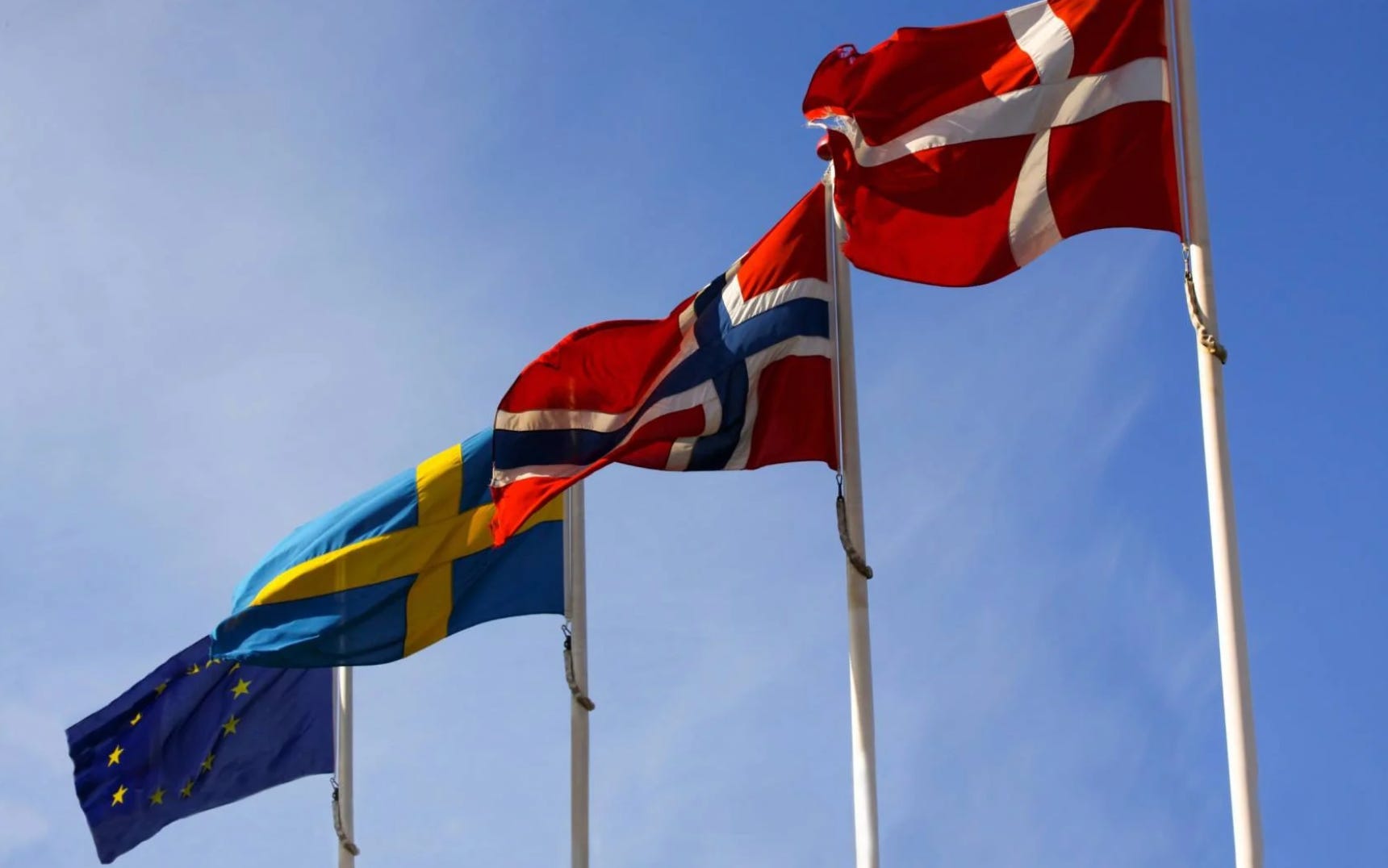
From a distance, Scandinavia appears politically uniform. Denmark, Norway, and Sweden are often treated as interchangeable small, wealthy welfare states with similar institutions and values. Yet their initial relationship to the European Union tells a different story. Over the past half century, the three countries have taken different paths: Denmark joined early, Norway negotiated twice and rejected membership twice, while Sweden stayed out for decades before suddenly u-turning in the 1990s.
In an earlier essay on Scandinavia’s diverging approaches to immigration and multiculturalism, I argued how the three countries developed distinct political cultures over the 19th and 20th centuries. Those same ideas reappear when the debate turns to Europe. Denmark approached the EU defensively and based on maintaining a political consensus. Norway experienced it as a threat to popular self-rule. In Sweden, the European project was part of a wider polarised discussion between left and right on what the state and national identity ought to be. However, the Scandinavian countries have in common that for long European integration was framed primarily as an economic project.
That era is ending. Russia’s war against Ukraine and the growing uncertainty over the United States’ commitment to Europe’s security have reshaped the debate. Across Scandinavia, the pro-EU camp is no longer driven by markets or efficiency, but by security. If European integration now deepens, it may not be because voters have been persuaded of its economic virtues. It may be because geopolitics has returned and because the European Union is increasingly seen not just as a market, but a shield.
I. 🇩🇰Denmark: pragmatic and first to join
Denmark was the first Scandinavian country to join the European Economic Community in 1973, and its early entry reflected a unique convergence of geopolitical alignment, economic structure, and political culture.
Unlike Sweden, Denmark did not sacralise neutrality. After World War II, Danish foreign policy aligned firmly with the West through NATO-membership. This alignment reduced the perceived geopolitical cost of European integration1. Europe was not an alternative to Atlanticism; it was an extension of it. This became a more compelling argument when Nordic cooperation on foreign policy failed due to Swedish-Finnish neutrality clashing with Danish-Norwegian reliance on the US.
Economically, Denmark’s export-oriented agricultural sector played a decisive role. Danish farmers depended on access to European markets with United Kingdom and West-Germany being their largest trade partners. Denmark is so intensively cultivated (60% of land), it produces far more food than its domestic population can consume. For such a sector to thrive, it requires unhindered access to large export markets. In Norway and Sweden, on the other hand, the agricultural sector is respectively constrained by harsh geography and small-scale; thus vulnerable to foreign competition and in favour of protectionism2. This explains why the Danish centre-right and agrarian-interests Venstre party became an early pioneer of European integration, while its counterparts in Norway (Senterpartiet) and Sweden (Centerpartiet) were sceptical.
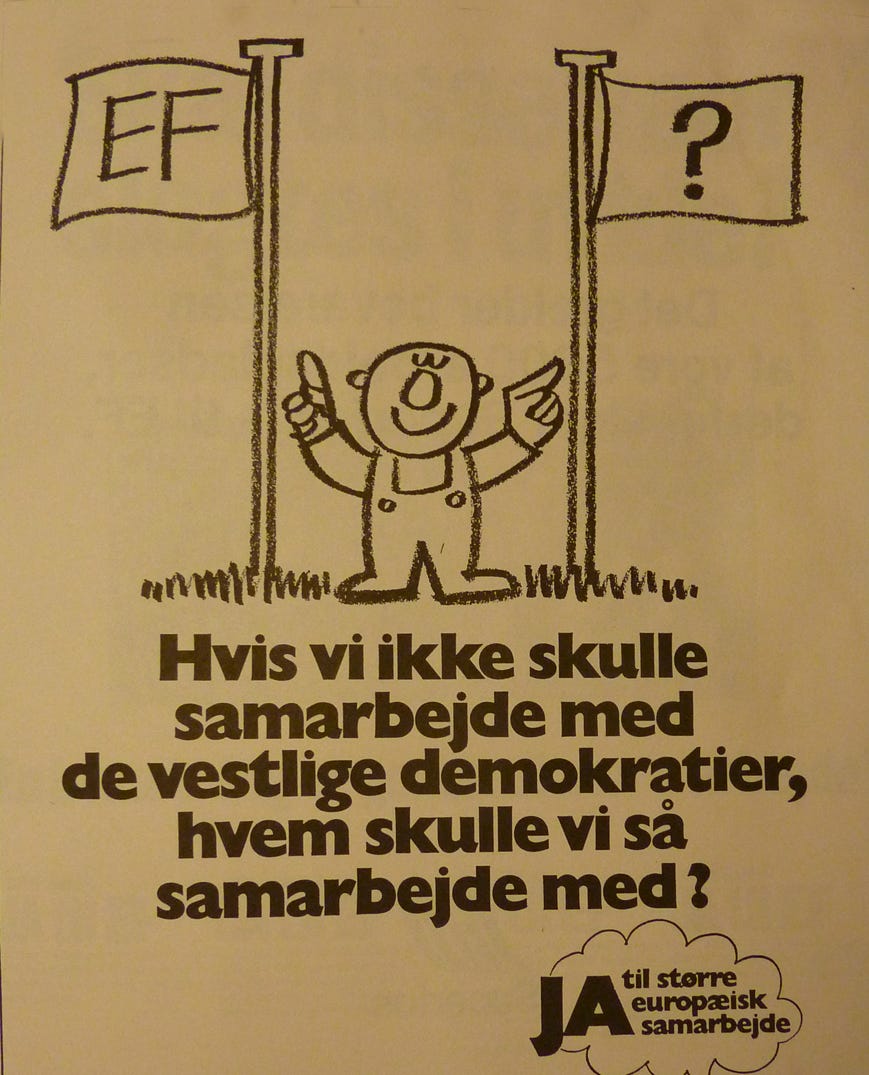
Politically, Denmark’s consensus-based system facilitated early agreement. Besides the centre-right, also the Social Democrats largely supported EEC membership3. Opposition existed, but it was marginal—confined primarily to the Socialist People’s Party. Opponents evoked anti-German sentiments from World War II and fears that the loss of sovereignty could threaten the welfare state. The road to membership was nonetheless delayed. Denmark’s fate was tied to Britain’s. When Charles de Gaulle vetoed British entry, Denmark turned to alternatives: EFTA and Nordic cooperation. But these projects failed to offer a viable long-term substitute. When the door reopened, Denmark walked through it. The 1972 referendum confirmed the political settlement: 63.4% voted yes. Interestingly, the municipalities that experienced more Nazi-inflicted violence in World War II were more likely to vote against EEC-membership4.
II. 🇳🇴Norway: votes no in 1972, democratic identity prevails
Norway’s 1972 referendum unfolded under similar institutional conditions and produced the opposite result. Like Denmark, Norway was firmly anchored in NATO. Like Denmark, its political elite—across Labour and Conservative parties—supported EEC membership. Business interests largely favoured integration. And like Denmark, Norway held a referendum. The difference lay not in elite opinion, but in political culture.
Norwegian democracy had long been defined by resistance to external authority. Sovereignty was not abstract; it was popular. The idea of “no foreign rule” was deeply embedded in national identity, shaped by late independence and rural social structures. This identity translated into political organisation. The no-side mobilised early, broadly, and emotionally. Farmers, fishers, and rural communities viewed the EEC as a threat not only to livelihoods (as earlier explained), but to the democratic fabric of the nation. As a result, the Popular Movement Against Norwegian EEC-Membership became a true grassroots movement with over 130,000 members56.
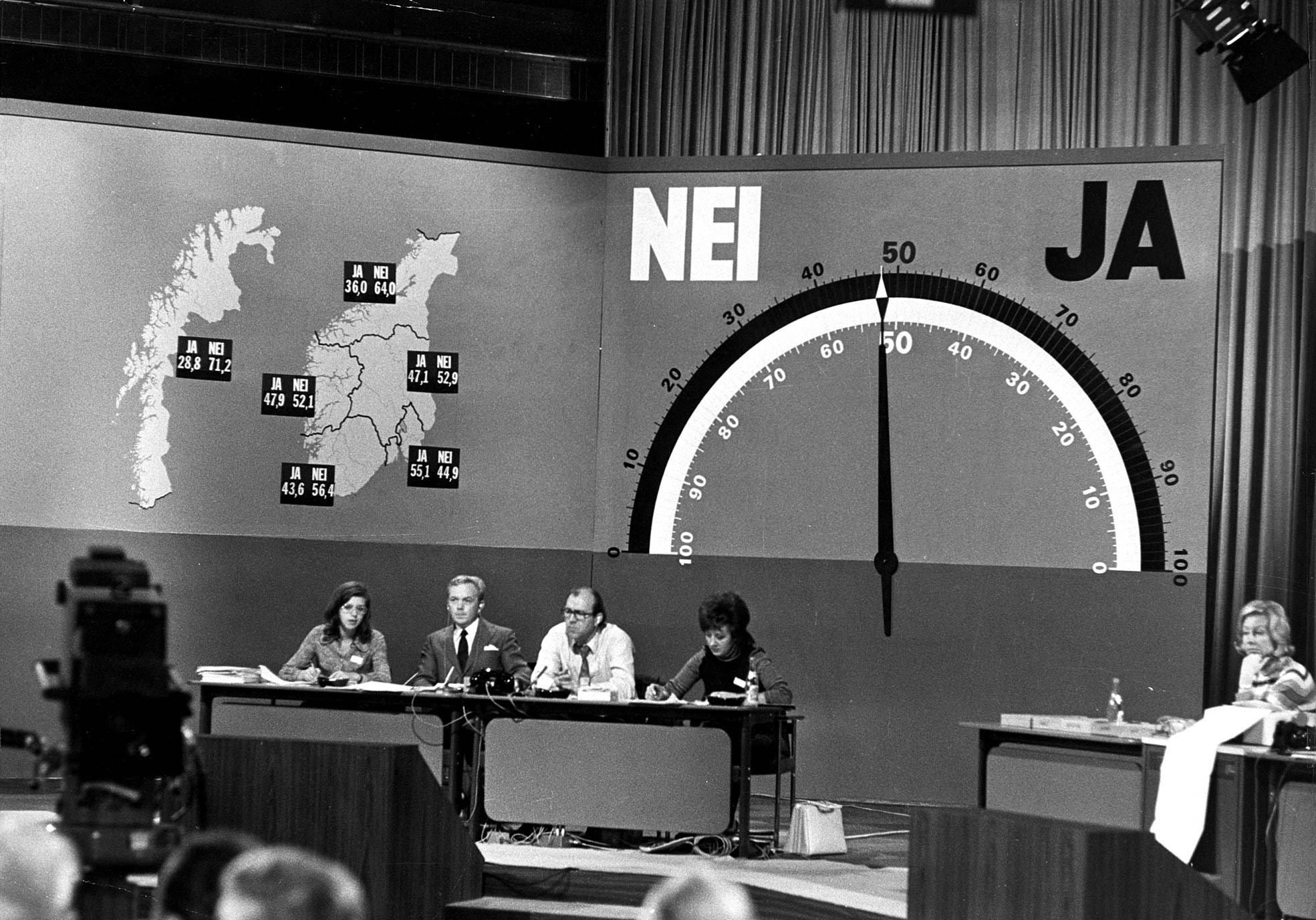
The yes-side, by contrast, relied heavily on economic argumentation. It emphasised market access, growth, and geopolitical influence. These arguments resonated poorly in a society where autonomy mattered more, while the economy was perceived as well-performing—especially after the discovery of oil in the 1960s. Furthermore, the pro-EEC Labour government faced resistance among its trade union base which argued that the “capitalist” centre-right being in favour as well proved that membership posed a threat to the welfare state. The no-side won with 53.5%; a big defeat for the political establishment. The result established a narrative that would remain remarkably stable over time: Europe as elite project infringing Norway’s democratic sovereignty.
III. 🇸🇪Sweden: neutrality, indecisiveness, and identity conflict
If Denmark moved early and Norway resisted decisively, Sweden hesitated. Or rather, the Social Democrats—non-stop in government for four decades straight—hesitated.
Swedish neutrality was not merely a strategic choice to stay outside major wars on the continent—as envisioned by King Karl XIV Johan in 1814. It had developed into a moral identity. For the Social Democrats, neutrality underpinned Sweden’s self-image as mediator, humanitarian actor, and moral voice in international politics7. Olof Palme reinforced this stance through Third World solidarity. His foreign policy vision depended on distance from Western power blocs8. European integration threatened to blur this identity. Furthermore, Swedish policymakers feared that EEC membership would expose Finland to pressure from the Soviet Union, as it would effectively push the East-West border into the Baltic Sea. Hence they preferred a Nordic union9.
In addition, the Social Democrats viewed European integration with suspicion. The EEC was associated with Christian democratic and liberal traditions that conflicted with Sweden’s state-centred social welfare model. And the industrial sector was sceptic of sharing sovereignty over the steel and metal industry10. This combination produced institutional ambivalence. Sweden sought economic cooperation without political integration. Prime Minister Tage Erlander’s (r. 1946-1969) attempt to negotiate a trade-focussed association without political membership reflected a desire to access markets while preserving autonomy11.
Consequently, the centre-right saw Europe differently. For Moderates and Liberals, the EEC offered a way to implement economically liberal reforms by shifting authority to the European level. Europe was not a threat, but a tool in a broader quest to reshape Swedish society and national identity. This motive is reflected in the writings of former Moderate politician Lars Tobisson who established his party’s ties to conservative parties across Europe12. He describes how he was inspired by Thatcher’s Conservatives and Kohl’s CDU and viewed the EEC as a way to embrace similar policies and escape the Social Democrats’ dominance. Besides that, enthusiasm for European integration also reflected how the Moderates distanced themselves from their flirtations with nationalist and fascist ideas in the 1930s that had tainted the party’s image after World War II13.
Still, Sweden stayed out. The Social Democrats remained dominant in government. And when the Moderates and Liberals did enter government in 1976-1982, it was together with the agrarian Centre Party which resisted political approximation to the continent.
IV. 🇩🇰Denmark: opt-outs and at the side line
In the first decade after accession, Danish membership remained relatively uncontested. The EEC was still largely an economic project, and the core arguments that had carried the 1972 referendum (market access, agricultural exports, economic stability) continued to hold14.
Centre-right Venstre and the Conservatives—who governed in the 1980s— were the most pro-integration, framing the EEC as a platform for Danish influence and an economic engine. The Social Democrats adopted a balancing act. Historically internationalist, they increasingly emphasised social protections and national control to reassure skeptical voters. The Socialist People’s Party (SF) was the primary euro-sceptic force, criticising the European integration as neoliberal and democratic-deficient while accepting membership as a fact15. Furthermore, a one-issue eurosceptic list—People’s Movement Against the EU—ran in European Parliament elections, getting its best results in left-wing strongholds, like Copenhagen16.
As integration deepened in the 1980s, discussions flared up. The emergence of the Single European Act and discussions about political union raised anxieties that Europe was no longer merely facilitating trade, but increasingly shaping law, citizenship, and sovereignty. This shift exposed a latent tension in Danish political culture. Denmark had long combined a strong state with a strong conception of popular sovereignty. European integration began to test the boundaries between those two traditions.
The Maastricht Treaty represented this tension. It formalised European citizenship, laid the groundwork for monetary union, and expanded cooperation into justice and security. For many Danish voters, this crossed a line. The 1992 referendum result—a narrow no—was a profound shock to the political establishment. Virtually all major parties, except for SF, had supported the treaty. The defeat revealed the depth of the gap between elite Europeanism and popular scepticism.
Therefore, SF—the main no-party that had never been in government before—was invited to negotiate a compromise so Denmark would not be forced to leave the union once the EU Treaty came into effect. The Edinburgh Agreement created four opt-outs—on the euro, defence, justice and home affairs, and EU citizenship. This solution allowed Denmark to remain inside the EU while symbolically reasserting national sovereignty17. Eventually, SF embraced fully EU-membership in an attempt to make itself fit for government.
Crucially, the opt-outs transformed euroscepticism from a binary choice into a managed condition. Danish voters were no longer asked whether Denmark should be in Europe, but how much Europe Denmark could tolerate. But this solution also restricted Denmark’s influence in Brussels. Hence, in 2000, the Social Democrat government attempted to abolish the opt-out on the euro, without success. Danes rejected the common currency. The campaign revealed the limits of elite persuasion. Economic arguments failed to overcome fears of losing monetary sovereignty and welfare-state autonomy.
Under the Venstre-Conservative governments of the 2000s, Denmark pursued a low-profile European strategy, as the parties domestically relied on support from the far-right eurosceptic Danish People’s Party. European integration was not actively opposed, but it was not championed either. The centre-right who traditionally functioned as engine for Europeanism were curtailed by their coalition partner. The 2008 financial crisis reinforced popular scepticism, with voters feeling relieved they had rejected the euro. Europe appeared more as a source of instability. The failed 2015 referendum on abolishing the justice and home affairs opt-out confirmed that the basic pattern persisted: elites argued efficiency and influence; voters guarded sovereignty18.
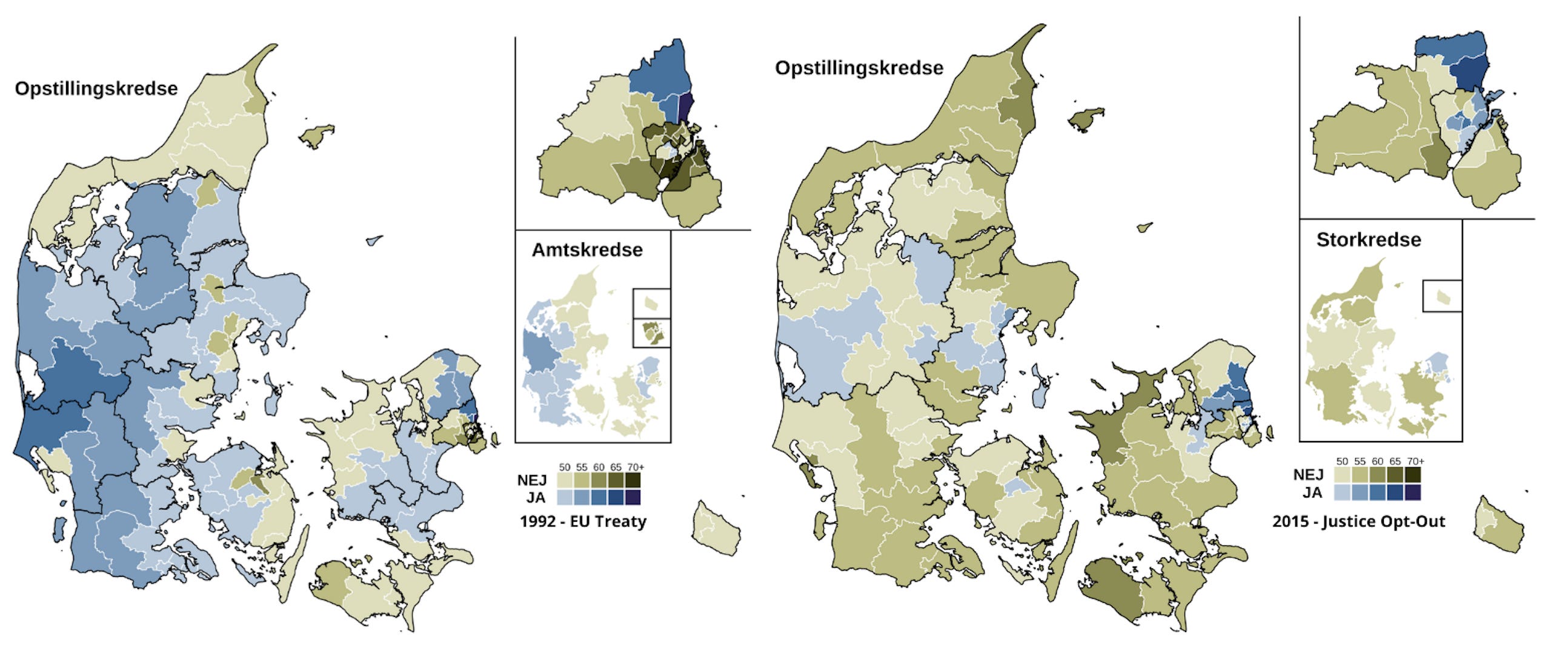
Danish euroscepticism has increasingly become more right- than left-coded with SF shifting towards a pro-EU stance while the far-right has grown in support. This can be seen when comparing the 1992 and 2015 referendums. In 1992, most no-votes were in the left-leaning neighbourhoods and suburbs of Copenhagen. In 2015, the anti-EU centre of gravity has moved to rural areas.
V. 🇳🇴Norway: institutionalised resistance, no wins again
Between 1972 and 1994, Europe had changed dramatically. The Cold War ended. The European Union replaced the European Community. Norway itself had become wealthier, more confident, and more globally connected through oil and gas exports. Yet when asked again whether to join, Norwegians responded almost exactly as before: 52% voted no19.
One reason lay in economics—but not in the way proponents expected20. By 1994, Norway was doing well. Oil revenues had transformed the economy. Unemployment was low. Growth was strong. Moreover, the European Economic Area (EEA) agreement fundamentally altered the debate. The EEA guaranteed Norway access to the single market even in the event of a no-vote. This combination neutralised the yes-side’s strongest argument: that Norway would be economically isolated outside the EU.
As in 1972, the no-side was mobilised more effectively. Grassroots organisations, particularly in rural areas, framed the EU as incompatible with Norwegian democracy. The narrative was not anti-European per se; it was anti-centralisation. Brussels symbolised distance, technocracy, and elite rule. Oslo itself was not entirely trusted—but Brussels was worse.
The 1994 referendum reshaped Norwegian party politics more deeply than its Danish counterpart21:
The Centre Party emerged as the institutional heart of euroscepticism. Its fierce opposition to EU membership led to electoral success and triggered a strategic realignment. No longer anchored on the pro-EU Conservatives and liberal Venstre on the right, the party moved toward the left-wing bloc, reshaping coalition dynamics for decades22.
The Labour Party, which supported membership, was badly bruised by the result. Its electorate was split in half. This internal division would haunt Labour leaders and make future referendums politically toxic, especially as its coalition partners (Socialist Left and Centre) were anti-EU.
In the years that followed, Norway settled into its EEA arrangement. This produced a peculiar political condition: deep integration without representation. Norway adopted vast amounts of EU legislation without having a vote. Over time, this generated unease—particularly around labor migration and regulatory autonomy. Yet paradoxically, it also reinforced scepticism. The EU appeared powerful but unaccountable; influential but distant. A climax of this uneasiness came in January 2025, when the Centre Party quit the Støre (Labour) government, refusing to agree on adopting EU regulations on green energy23.
VI. 🇸🇪Sweden: U-turn and the Social Democratic civil war
In October 1990, the Social Democratic Prime Minister Ingvar Carlsson (r. 1986-1991; 1994-1996) suddenly announced Sweden’s intention to seek EU membership. The decision was taken by a small inner circle, under conditions of acute crisis24. The Finnish government even complained that they were not informed beforehand, considering the countries had tied security interests vis à vis the Soviet Union25. Sweden was experiencing its deepest financial crisis since the 1930s, with markets failing to regain trust despite earlier economic reform packages. The Finance Minister back then, Allan Larsson, himself describes this sudden change as an attempt to turn the crisis26. The end of the Cold War was used as an excuse to say that joining the EU would no longer violate the policy of neutrality. This was necessary as Social Democrats were internally split on whether to join the EU27.
The Moderates welcomed this decision . When their leader Carl Bildt (r. 1991-1994) became prime minister, he enthusiastically continued negotiations, framing it as Sweden’s “return to Europe”. One would think that finally a consensus had emerged between the Swedish left and right. On the contrary, the Social Democrats accused Bildt of going too far as he also wanted to join the Monetary Union, warning that this would lead to a victory for the no-side28. Polls had shown a decline in support for membership, as Sweden’s financial crisis worsened as a result of the German Bundesbank raising interest rates to fight inflation. Eventually, Bildt backed down and the euro question would be postponed.
The 1994 referendum passed narrowly: 53% of Swedes voted yes to EU-membership. The coalition in favour was broad but shallow. Opposition was concentrated on the left (spearheaded by the Greens and Left Party) and in rural areas, but lacked the organisational coherence of Norway’s no-movement. Social Democrats like to claim that the yes-side only won thanks to them defeating Carl Bildt in the election weeks earlier, after which Carlsson returned as prime minister. A Social Democrat government in place may have convinced enough left-leaning that the welfare state would not be at risk29.
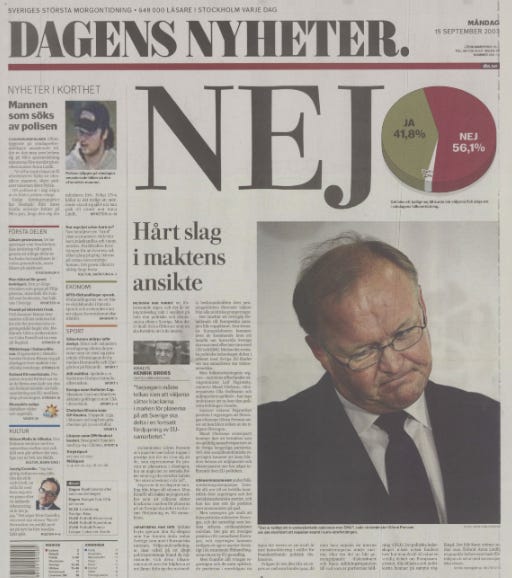
The euro referendum of 2003 exposed the unresolved conflict at the heart of Swedish social democracy30. Göran Persson (r. 1996-2006), a powerful and pragmatic prime minister, supported euro adoption. He framed it as a matter of influence and responsibility. Sweden, he argued, could not shape Europe from the margins. Within his own party, opposition was fierce. Many Social Democrats viewed the euro as incompatible with the Swedish model. Monetary sovereignty was seen as essential for maintaining full employment and welfare spending31. The party split almost down the middle. Trade unions were divided. Grassroots activists rebelled. The campaign became a proxy war over the future of social democracy itself. Meanwhile, the Centre Party had returned to its eurosceptic stance and opposed the common currency as its rural base opposed further integration. Voters rejected the euro: 56% to 42%.
VII. 🇩🇰Denmark: Ukraine and Greenland push integration
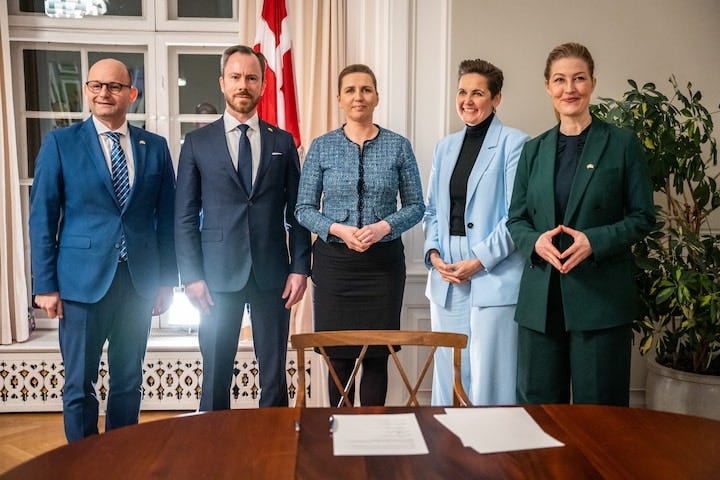
What economics could not do, security eventually did. Russia’s invasion of Ukraine and Donald Trump’s not only open scepticism toward NATO—but also aspirations to take over Greenland—fundamentally altered the context in which European integration was debated. For the first time, Europe was no longer framed primarily as an economic or regulatory project, but as a potential security provider.
This reframing proved decisive. In 2022, Danish voters abolished the defence opt-out: 67% against 33%32. A broad coalition of parties (Social Democrats, Venstre, SF, Liberal Alliance, Conservatives, social-liberal Radikale) supported this while only left-wing Enhedslisten and far-right DF opposed it. This 67-33 result move would have been unthinkable a decade earlier. The campaign succeeded precisely because it bypassed economic abstraction and appealed directly to existential fear: Denmark could no longer afford to sit out European defence cooperation33. This was a turning point. It revealed that Danish euroscepticism was not absolute. When Europe appeared as a guarantor of security, it was embraced.
Yet even this breakthrough has clear boundaries. While Venstre officially supports abolishing the remaining opt-outs, it does not advocate for it. The broader right-wing bloc remains deeply skeptical and to claim the post of prime minister in the future, Venstre is dependent on them. The euro and justice opt-outs persist, and there are no polls indicating voters would want to abolish them34. The Social Democrats tread carefully, aware that enthusiasm for Europe remains shallow and contingent. Despite Mette Frederiksen being one of the leading heads of government in the EU that calls for increased integration on security, especially as Trump poses an increasingly serious threat to Danish sovereignty over Greenland35.
VIII. 🇳🇴Norway: security anxiety meets democratic paralysis
Over time, the democratic implications of Norway’s out-yet-also-somewhat-in position have become harder to ignore. EU rules increasingly shape Norwegian labour markets, migration patterns, and regulatory frameworks. Yet Norwegian voters have no formal say in how those rules are made. This together with Europe failing to effectively handle several crises hardened resistance. Europe appeared not only infringing, but also unnecessary.
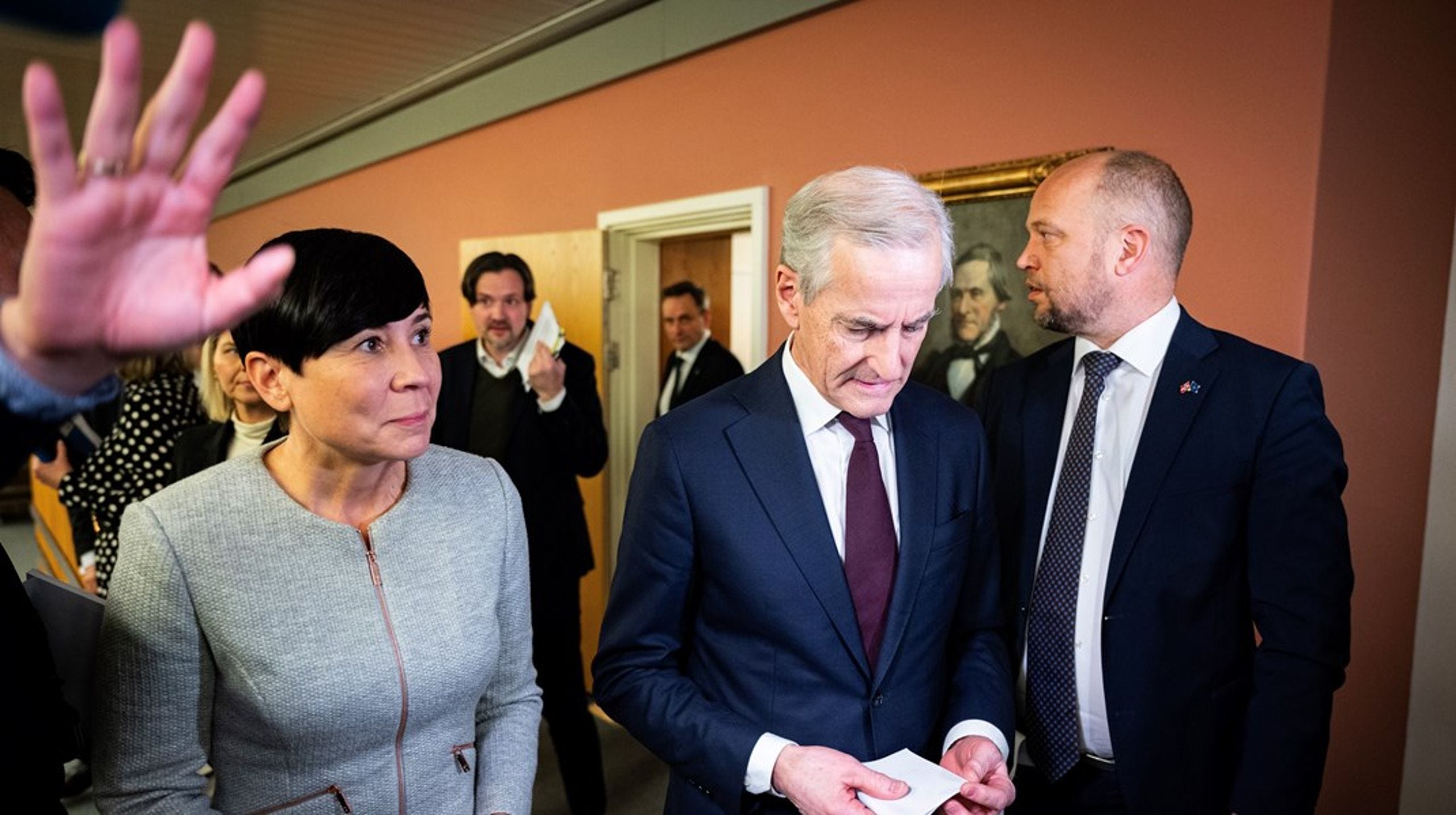
The war in Ukraine disrupted this narrative. For the first time since the Cold War, Norwegians confronted a direct military threat in their region. Simultaneously, Donald Trump’s hostility toward NATO raised questions about the reliability of the American security guarantee. These developments triggered a noticeable increase in support for EU membership. Security arguments gained traction. Europe was reframed as a potential stabiliser in an increasingly volatile world. In 2023, the Greens adopted a pro-membership stance, joining Venstre and the Conservatives36. The latter party is even expected to elect a staunch pro-EU politician—One Eriksen Søreide—as its new leader in February, while members recently passed a motion that calls for membership negotiations to start soon3738. And in the Spring of 2025, support for joining the EU reached new highs: the no-side’s lead had shrunk to just six points39. Especially on the left, support for EU-membership has grown.
But the momentum proved fragile. A tariff dispute, this autumn, with the EU reignited old resentments and quickly dampened enthusiasm40. A poll in December shows that the no-side’s lead has surged back to 53% against 33% for the yes-side41. More importantly, Norway’s party system remains structurally hostile to another referendum42. The Labour Party’s electorate is split almost perfectly in half on EU membership. For its leadership, the risk of reopening the issue is existential. A referendum could fracture the party. And Støre is dependent on support from the Centre and far-left Red parties—both staunchly anti-EU—to govern. On the right, the openly pro-EU Conservatives and Venstre depend on the Progress Party—by far the largest and most dominant force of the bloc that is resolutely anti-EU. This makes a parliamentary path to membership extremely unlikely.
Norway thus finds itself in a strategic deadlock: increasingly aware of the costs of exclusion, yet politically incapable of choosing inclusion. Security may push the debate forward. However, it cannot, on its own, dissolve decades of democratic identity built around the right to say no. At least, for now.
IX. 🇸🇪Sweden: from ambivalence to ambition?
Public opposition to the euro remains strong in Sweden. The dominant argument among opponents is not emotional but strategic: retaining monetary sovereignty allows Sweden to respond flexibly to crises and protect its welfare model, scarred by memories from the 1990s when German interest rates havocked Swedish state finances43. Recent increases in euro support were driven largely by the krona’s depreciation rather than by ideological conversion44. When the currency stabilised, the growth in support stopped45. This underscores a persistent pattern: economic arguments alone are insufficient to overcome sovereignty concerns. Nevertheless, Sweden only applied for EU- and NATO-membership amid acute crisis: financial turmoil and the war in Ukraine respectively46. And there’s no ‘crisis situation’ yet that could reassure support for the euro.
Yet elite discourse has shifted. The Liberals openly advocate immediate euro adoption (though mostly to attract voters’ attention amid abysmal polling below the electoral threshold)47. The Moderates increasingly frame the euro not as an economic issue, but as a geopolitical one: full participation is necessary to influence European decision-making in an era of security concerns48. “We must Trump-secure” ourselves is the mantra, referring to Trump’s lack of interest for Europe’s security.
The obstacle is political reality. The governing right-wing bloc depends on the far-right Sweden Democrats, whose euroscepticism is rooted in nationalism and distrust of supranational authority. As long as they remain the dominant force on the right, euro adoption is effectively blocked. This has produced an ironic situation: the parties most eager to deepen EU integration lack the autonomy to do so.
This is where Swedish political culture may again surprise. The Social Democrats, long ambivalent about Europe, have demonstrated a capacity for decisive leadership under security pressure. The party initiating Sweden’s accession to NATO—achieved despite resistance from their coalition partners (Left Party and Greens)—illustrated that deeply rooted identities can be overridden when elites frame change as existential necessity. Within the Social Democrats that suffered from years of infighting over the EU, a new narrative is emerging. The EU is no longer viewed primarily as a neoliberal constraint, but as a platform for reshaping globalisation.
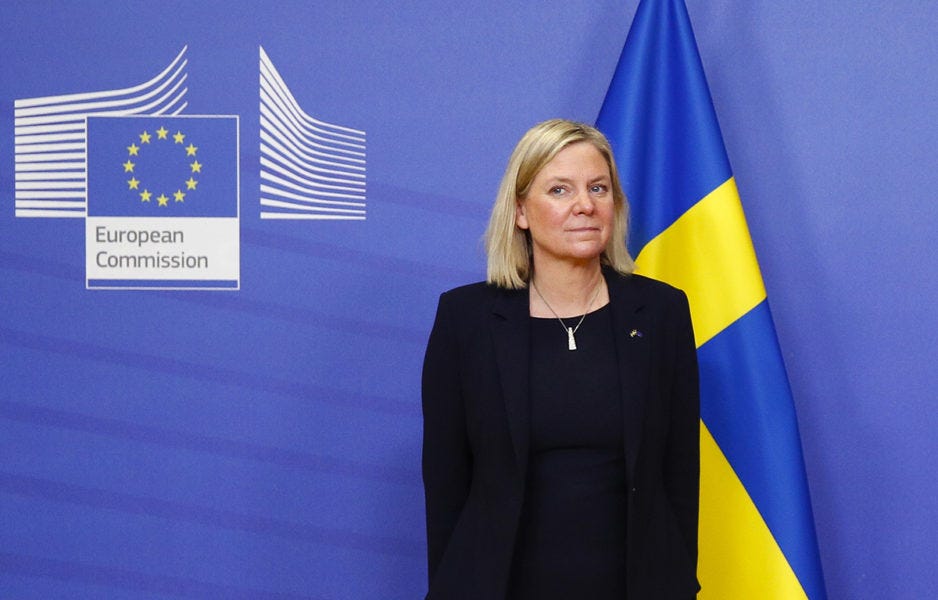
Environmental policy, industrial strategy, social standards, and joint debt are areas where Swedish social democracy sees opportunity rather than threat. The 2017 Gothenburg social summit symbolised this ambition: an attempt to imprint a Nordic-social democratic vision onto the European project. And Social Democrat leader Magdalena Andersson envisions Sweden as the one that should lead Europe into the green transition, providing mineral resources and inspiration on how to expand renewable energy49. Similarly, likely coalition partners have become more pro-EU: Greens dropped their opposition to membership over a decade ago and the Centre Party recently opened the door to adopting the euro5051. However, Andersson herself has yet to openly speak out in favour of abandoning the krona. When asked, she vaguely says she wants to hold a public debate about the euro and that “both arguments in favour and against have strengthened”52.
Perhaps most strikingly, voices within Swedish social democracy now speak openly of an EU defence capacity, an EU army, not merely as a complement to NATO, but as its substitute53. This reflects that the party’s u-turn on NATO-membership was reluctant, but also that the Social Democrats’ ambivalence towards Europe is largely gone. And it suggests that the EU’s future legitimacy in Sweden may rest less on markets or identity than on protection.
If deeper EU integration occurs in Scandinavia, Sweden is the most likely catalyst because its dominant political force is capable of reframing Europe as a moral and strategic necessity. Even the former secretary of Moderate Prime Minister Ulf Kristersson and CEO of the right’s main think tank Timbro, Peter Magnus Nilsson, thinks that it is the Social Democrats that will lead Sweden into the eurozone54. Once again. Just like with the EU and NATO. And polls show that the Social Democrats are likely to return power coming autumn.
X. Conclusion: EU as a new NATO?
For half a century, Denmark, Norway, and Sweden have different roads into—and around—Europe. Denmark managed integration through compromise and opt-outs; Norway turned resistance into a democratic identity; Sweden oscillated between hesitation and sudden leaps, shaped by crises and domestic ideological struggle. These paths reflected political cultures forged in the twentieth century—distinct ideas about sovereignty, democracy, and the moral role of the state, as discussed in my previous essay.
What has changed is not those cultures, but the context surrounding them. For decades, economic arguments were the core pro-EU sentiments. Markets could be weighed against autonomy. Today, that framing is no longer sufficient. Russia’s war against Ukraine and the growing uncertainty surrounding American power have returned geopolitics to the centre of European life.
Across Scandinavia, support for the EU now grows fastest where security is at stake and fades where it is not. The future of European integration may no longer be decided by prosperity or market efficiency, but by fear, protection, and survival. If the European Union is to integrate further, it may be because it is increasingly asked to perform a role it was never really designed for: not just to organise markets, but to guarantee safety. And this beds the question: lies the EU’s future in NATO’s worsening dysfunction?
Olesen, Thorsten Borring: Danmark og europæisk integration før 1973 i Danmarkshistorien på lex.dk. Hentet 31. december 2025 fra https://danmarkshistorien.lex.dk/Danmark_og_europ%C3%A6isk_integration_f%C3%B8r_1973
Nordic Council — Norden, Agricultural land use in the Nordic countries, https://pub.norden.org/temanord2025-550/chapter-1-agricultural-land-use-in-the-nordic-countries.html
Olesen, Thorsten Borring: Danmark og europæisk integration før 1973 i Danmarkshistorien på lex.dk. Hentet 31. december 2025 fra https://danmarkshistorien.lex.dk/Danmark_og_europ%C3%A6isk_integration_f%C3%B8r_1973
Aaskoven, Lasse (2022). “Foreign Occupation and Support for International Cooperation: Evidence from Denmark”. World Politics. 74 (2): 285–325. doi:10.1017/S004388712200003X. ISSN 0043-8871. S2CID 248267466
Tvedt, Knut Are: EU-kampen i Store norske leksikon på snl.no. Hentet 31. desember 2025 fra https://snl.no/EU-kampen
Kristoffersen, Dag Axel: Norges nei til EF i 1972 i Norgeshistorie. Hentet 31. desember 2025 fra https://www.norgeshistorie.no/oljealder-og-overflod/1945-norges-nei-til-ef-i-1972.html
Nilsson, T. (2022, April 26). Torbjörn Nilsson: Kan vi gå ur NATO när kriget i Ukraina tagit slut? Svenska Dagbladet. https://www.svd.se/a/8QMwo2/torbjorn-nilsson-kan-vi-ga-ur-nato-nar-kriget-i-ukraina-tagit-slut
Nilsson, T. (2022, April 13). Debatten om Nato: Så har S drivit en självständig utrikespolitik. Svenska Dagbladet. https://www.svd.se/a/y4d5mK/debatten-om-nato-sa-har-s-drivit-en-sjalvstandig-utrikespolitik
Nilsson, T. (2022, March 8). Torbjörn Nilsson: Elitens hemlighet – därför har Nato varit ickefråga. SvD.se. https://www.svd.se/a/KzR5Q7/torbjorn-nilsson-elitens-hemlighet-darfor-har-nato-varit-ickefraga
Höglund, Lena: Europeiska unionen — Framväxten i Landguiden. Hämtad 31 december 2025 från https://www.ui.se/landguiden/internationella-organisationer/europeiska-unionen/framvaxten/
Svenska Dagbladet. (2011, August 21). Erlanders nej höll Sverige utanför Europa. SvD.se. https://www.svd.se/a/f10bfbb3-b5ae-351e-a6d2-dfaa89f77720/erlanders-nej-holl-sverige-utanfor-europa http
Tobisson, L. (2003, February 27). Nationalisterna blir Europavänner. Svensk Tidskrift. https://www.svensktidskrift.se/2003-2/2003-2-37.html
Nikkinen, A. (1984). Nationalismens roll i Moderaternas historia [Thesis]. https://www.diva-portal.org/smash/get/diva2:1881392/FULLTEXT01.pdf
Danmarks medlemskab af EF og EU, efter 1972 i Danmarkshistorien på lex.dk. Hentet 31. december 2025fra https://danmarkshistorien.lex.dk/Danmarks_medlemskab_af_EF_og_EU,_efter_1972
DR Nyheder. Historien om SF — PARTIET, DER KNÆKKEDE, DA DET NÅEDE TOPPEN - OG MÅTTE STARTE FORFRA IGEN. https://www.dr.dk/nyheder/webfeature/socialistiskfolkeparti
Olesen, Thorsten Borring: Danmark i EF: 1973-1993 i Danmarkshistorien på lex.dk. Hentet 31. december 2025 fra https://danmarkshistorien.lex.dk/Danmark_i_EF_1973-1993
Olesen, Thorsten Borring: Danmark i EU: 1993-2012 i Danmarkshistorien på lex.dk. Hentet 31. december 2025 fra https://danmarkshistorien.lex.dk/Danmark_i_EU_1993-2012
Nedergaard, Peter: danske EU-forbehold i Lex på lex.dk. Hentet 31. december 2025 fra https://lex.dk/danske_EU-forbehold
Tvedt, Knut Are: EU-kampen i Store norske leksikon på snl.no. Hentet 31. desember 2025 fra https://snl.no/EU-kampen
Kristoffersen, Dag Axel: Norges nei til EU i 1994 i Norgeshistorie. Hentet 31. desember 2025 fra https://www.norgeshistorie.no/oljealder-og-overflod/1946-norges-nei-til-eu-i-1994.html
Sejersted, Francis: Norges historie etter 1990 i Store norske leksikon på snl.no. Hentet 31. desember 2025 fra https://snl.no/Norges_historie_etter_1990
Tvedt, Knut Are; Garvik, Olav: Senterpartiet i Store norske leksikon på snl.no. Hentet 31. desember 2025 fra https://snl.no/Senterpartiet
Ekholt, C., Waaler, E., & Einarsdóttir, S. B. (2025, January 30). Hvorfor krangler Arbeiderpartiet og Senterpartiet om EU-direktiver og strøm? Her får du svaret. NRK. https://www.nrk.no/norge/hvorfor-krangler-arbeiderpartiet-og-senterpartiet-om-eu-direktiver-og-strom_-her-far-du-svaret-1.17224079
Nilsson, T. (2023, January 12). Torbjörn Nilsson: Nya Euro-ivrarna missar en viktig detalj. Svenska Dagbladet. https://www.svd.se/a/pQnrPw/torbjorn-nilsson-nya-euro-ivrarna-missar-en-viktig-detalj
Johansson, Frederik. (2022, April 22). Nato får inte hanteras som EU. Timbro. https://timbro.se/smedjan/nato-far-inte-hanteras-som-eu/
Larsson, Allan. (2019, November 13). Så blev Sverige medlem i EU | Dagens Arena. Dagens Arena. https://www.dagensarena.se/essa/sa-blev-sverige-medlem-eu/
Johansson, S. (2010). Socialdemokraterna och EU-medlemskapet. -En jämförande fallstudie om socialdemokraternas förhållningssätt till EU-medlemskapet över tid. In M. Nilsson (Ed.), C-uppsats I Statsvetenskap, 15 Hp. https://www.diva-portal.org/smash/get/diva2:321926/FULLTEXT01.pdf
Larsson, Allan. (2019, November 13). Så blev Sverige medlem i EU | Dagens Arena. Dagens Arena. https://www.dagensarena.se/essa/sa-blev-sverige-medlem-eu/
Larsson, Allan. (2019, November 13). Så blev Sverige medlem i EU | Dagens Arena. Dagens Arena. https://www.dagensarena.se/essa/sa-blev-sverige-medlem-eu/
Johansson, Frederik. (2022, April 22). Nato får inte hanteras som EU. Timbro. https://timbro.se/smedjan/nato-far-inte-hanteras-som-eu/
Jennbert, E. (2016). Politisk debatt om EMU-valet år 2003 : En analys kring politisk debatt inför folkomröstningen år 2003 och dess argument för- och emot ett inträde i EMU. Lund University Publications Student Papers (Lund University). http://lup.lub.lu.se/student-papers/record/8898976
Prakash, T. (2022, June 2). Ét forbehold blev stemt væk, ét blev uaktuelt, men de to sidste kan leve mange år endnu. DR Nyheder. https://www.dr.dk/nyheder/politik/folkeafstemning/et-forbehold-blev-stemt-vaek-et-blev-uaktuelt-men-de-sidste-kan-leve
Nedergaard, Peter: danske EU-forbehold i Lex på lex.dk. Hentet 31. december 2025 fra https://lex.dk/danske_EU-forbehold
Mortensen, E. N. (2025, April 1). Befolkningen har rykket sig på visse punkter. men kronen med kongen ”ønsker danskerne ikke at pille ved”. Kristeligt Dagblad. https://www.kristeligt-dagblad.dk/danmark/danskerne-vil-stadig-have-eu-forbehold-men-holdningen-til-faelles-forsvar-har-aendret-sig
Mette Frederiksen (Class of 2026). (2025, December). POLITICO. https://www.politico.eu/list/politico-28-class-of-2026/mette-frederiksen/
MDG krever EU-forhandlinger for å støtte Ap-regjering. (2025, May 8). Nationen. https://www.nationen.no/mdg-krever-eu-forhandlinger-for-a-stotte-ap-regjering/s/5-148-730182
Rønning, M., & Einarsdóttir, S. B. (2025, March 22). Vedtak på Høyres landsmøte: Høyre åpner for raske EU-forhandlinger. NRK. https://www.nrk.no/norge/vedtak-pa-hoyres-landsmote_-hoyre-apner-for-raske-eu-forhandlinger-1.17351655
Ine tør der Erna viker. (2025, November 23). Dagbladet. https://www.dagbladet.no/meninger/ine-tor-der-erna-viker/83883345
Trøen, O. M., Bransfjell, E. M., & Gildestad, B. A. (2025, March 13). Norsk EU-medlemskap: kun 6 prosentpoeng skiller ja og nei-siden. NRK. https://www.nrk.no/trondelag/norsk-eu-medlemskap_-kun-6-prosentpoeng-skiller-ja-og-nei-siden-1.17336600
Falnes, J. (2025, December). Nei-boom etter tollsjokk. TV 2. https://www.tv2.no/nyheter/innenriks/nei-boom-etter-tollsjokk/18351865/
Johnsen, A. B., & Røsvik, E. (2025, December 12). EU-måling: Ap-velgerne har gått fra ja til nei. VG. https://www.vg.no/nyheter/i/ExoL4A/eu-maaling-nei-siden-dobler-ledelsen
Arena Europa: Hva vil Arbeiderpartiet med EU og EØS? (2025, October 15). Arena Europa. https://www.sv.uio.no/arena/forskning/aktuelt/aktuelle-saker/2025/arena-europa-arbeiderpartiet-og-eu.html
Jerneck, M. (2025, December 4). Flytta inte över makten till bankirerna i Frankfurt. Aftonbladet. https://www.aftonbladet.se/debatt/a/q6pzE0/nej-till-euron
Allt färre svenskar emot euron – expert tror ändå inte på en snabb förändring. (2024, August 29). SVT Nyheter. https://www.svt.se/nyheter/uutiset/svenska/allt-farre-svenskar-emot-euron-expert-tror-anda-inte-pa-en-snabb-forandring
Rekordstöd för EU i Sverige – minskat intresse för euron. (n.d.). https://www.europaportalen.se/2025/06/rekordstod-eu-i-sverige-minskat-intresse-euron
Nilsson, T. (2023, January 12). Torbjörn Nilsson: Nya Euro-ivrarna missar en viktig detalj. Svenska Dagbladet. https://www.svd.se/a/pQnrPw/torbjorn-nilsson-nya-euro-ivrarna-missar-en-viktig-detalj
Svanström, S. (2025, April 11). Att byta till euron skulle Trump-säkra Sverige. Liberalerna. https://www.liberalerna.se/nyheter/att-byta-till-euron-skulle-trump-sakra-sverige
Malmén, J. (2025, October 16). Kristersson öppnar för en ny debatt om euron | Omni. Omni. https://omni.se/kristersson-oppnar-for-en-ny-debatt-om-euron/a/W0QrEQ
EU. (2024, December 18). Socialdemokraterna. https://www.socialdemokraterna.se/var-politik/a-till-o/eu
Mp-ledare har ändrat sig om EU. (n.d.). 8 Sidor. https://8sidor.se/sverige/2008/02/mp-ledare-har-andrat-sig-om-eu/
Partiledaren förlorade euro-omröstningen – nöjd ändå. (2025, November 14). Ekot | Sveriges Radio. https://www.sverigesradio.se/artikel/partiledaren-forlorade-euro-omrostningen-nojd-anda
Socialdemokraterna öppnar för en svensk eurodebatt. (2024, May). https://europaportalen.se/2024/05/socialdemokraterna-oppnar-en-svensk-eurodebatt
SSU. (2025, November 26). Försvarspolitik för ett starkare Sverige | SSU. https://ssu.se/var-politik/forsvarspolitik/
Politiken, A. I. (2025, April 28). PM Nilsson: Ta initiativ till en euro-option. Aktuellt I Politiken. https://aip.nu/pm-nilsson-ta-initiativ-till-en-euro-option/
Greetings Nassreddin! I find this article fantastically informative and insightful. Would you kindly grant me permission to translate the article and post it on another platform (the WeChat official account that I'm running)?